

Skip-Bo is a sequencing card game made by Mattel in which 2 to 6 players race to empty a personal “stock pile” of cards by playing them onto shared building piles in numerical order, 1 through 12. It is one of the best-known family card games in the world, sitting alongside UNO and Phase 10 in Mattel’s line-up, and it is easy enough for a seven-year-old to learn in a few minutes yet strategic enough to keep adults hooked.
This page is the starting point for everything on skip-bo.ca. Below you’ll find a plain-English overview of what the game is, how a turn works, what comes in the box, how many people can play, the main variations, and how Skip-Bo compares to similar games. Each section links to a fuller guide if you want to go deeper.
Skip-Bo Quick Facts
| Game type | Sequencing card game |
| Players | 2–6 (solo, partners or teams) |
| Recommended age | 7 and up (Junior edition: 5+) |
| Cards in the deck | 162 (144 numbered 1–12 + 18 Skip-Bo wild cards) |
| Objective | Be first to empty your stock pile by building piles 1→12 |
| Publisher | Mattel |
| First released | 1967 (created by Minnie Hazel “Skip” Bowman) |
What is Skip-Bo?
Skip-Bo is a commercial version of the classic card game Spite and Malice, redesigned to use its own dedicated deck instead of standard playing cards. The goal never changes: be the first player to get rid of every card in your stock pile. Everything else in the game — your hand, the discard piles, the wild cards — exists to help you do that faster than your opponents.
The game was created in 1967 by Minnie Hazel “Skip” Bowman of Brownfield, Texas, who named it after her own nickname. International Games bought the rights in 1980, and Mattel acquired International Games in 1992, which is why Skip-Bo is a Mattel title today. For the full story of the name, the inventor and how the modern deck evolved, see what Skip-Bo is and where it came from.
How to play Skip-Bo: the basics
The core rule of Skip-Bo is simple: on your turn you build shared piles upward in sequence from 1 to 12, and you win by clearing your stock pile before anyone else. A game uses four types of card locations — your stock pile, your hand, up to four shared building piles in the centre, and up to four personal discard piles in front of you.
A turn follows the same rhythm every time. You draw until you hold five cards, then play as many cards as you legally can from the top of your stockpile
, your hand, or your discard piles onto the building piles. A turn ends the moment you place one card onto a discard pile, so the discard is both how you end your turn and how you set up your next one. If you ever play all five cards from your hand, you immediately draw five more and keep going.
How a Skip-Bo Turn Works
- Draw to five. Start your turn by drawing from the central draw pile until you are holding five cards.
- Build the centre piles. Play cards in order (1, 2, 3…) onto the shared building piles, taking them from the top of your stock pile, your hand or your discard piles.
- Use wild cards wisely. A Skip-Bo wild card can stand in for any number — save it to clear a stock-pile card when it counts most.
- Discard to end your turn. Place one card onto any of your four discard piles. Your turn ends the moment you discard, so play everything you can first.
The first player to play the last card from their stock pile wins the game.
Setting up a game
Setup depends on how many people are playing. After a shuffle, each player is dealt a face-down stock pile: 30 cards each for 2 to 4 players, or 20 cards each for 5 or 6 players. The remaining cards form the central draw pile, and the top card of each stock pile is turned face up. For a full walkthrough with dealing counts and pile placement, see how to set up a game.
Winning and scoring
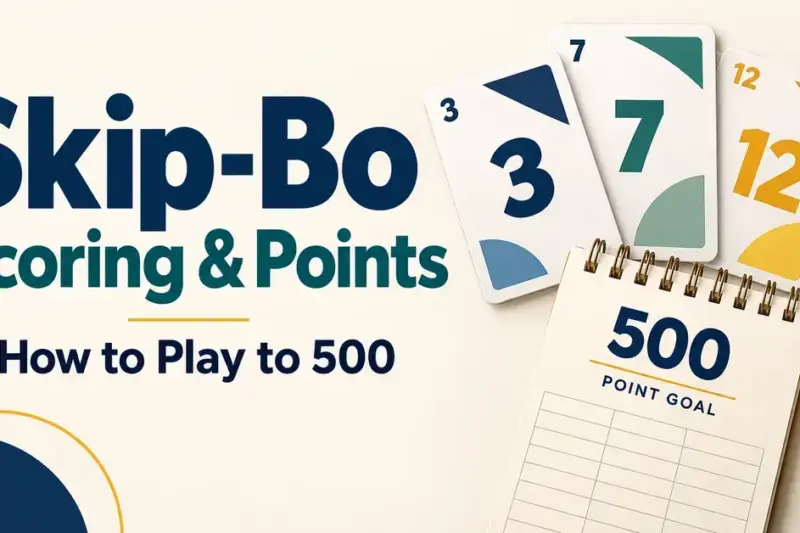
The first player to play the last card from their stock pile wins the game outright, so no points are needed for a casual session. If you prefer a longer match, Skip-Bo includes an optional scoring system: the winner scores 25 points for the win plus 5 points for every card still left in opponents’ stock piles, and players keep playing rounds until someone reaches a target total. The rules for keeping score explain the point system and common target totals in detail.
What’s in a Skip-Bo deck
A standard modern Skip-Bo deck contains 162 cards: 144 number cards (twelve each of the numbers 1 through 12) plus 18 wild “Skip-Bo” cards. The number cards are printed in three colours — blue, green and red — but the colours are purely decorative. Only the number matters, which is why the deck is designed to be fully colour-blind accessible.
A Skip-Bo wild card can stand in for any number you need, which makes it the most valuable card in the game and the one worth saving for the right moment. You may notice some retail listings — including certain Canadian ones — quote 168 cards rather than 162; that figure reflects the older International Games edition, which used 24 wild cards instead of 18. The Skip-Bo deck explained breaks down every card type and the differences between editions.
How many players can play Skip-Bo?
Skip-Bo is built for 2 to 6 players, and the same box supports several formats. You can play a straight free-for-all, pair up into partnerships, or split into teams — Mattel’s own rules cover partnered play where teammates work together to empty both of their stock piles.
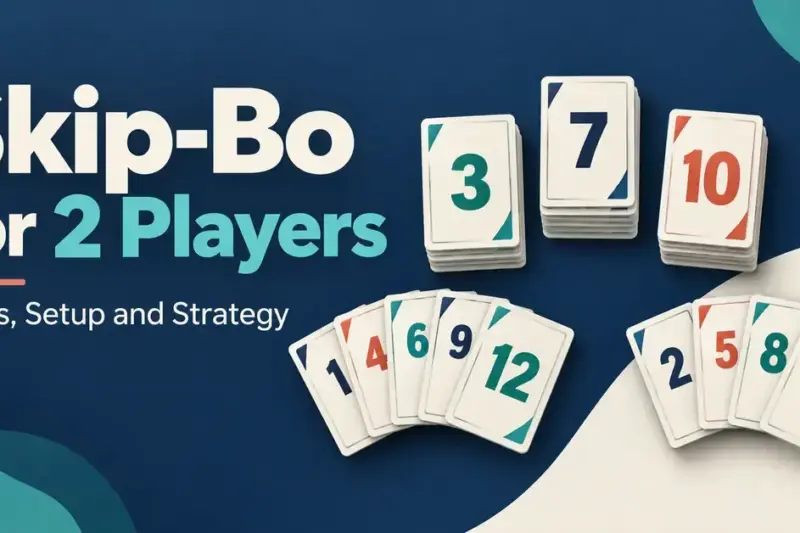
The two-player game plays quite differently from a full table, because there is only one opponent to read and block, so the discard-pile mindset matters more. Our guide to Skip-Bo with 2 players covers the head-to-head format and how the strategy shifts.
Skip-Bo variations and house rules
Beyond the standard rules, Skip-Bo supports a wide range of variations, from simple house rules to entirely different ways of dealing. Popular tweaks include shorter games (deal a 10- or 15-card stock pile) and longer two-player marathons (deal 40), and many families layer in their own rules about discard piles and blocking.
You don’t even need the branded box to play. Because Skip-Bo descends from Spite and Malice, you can recreate it with ordinary playing cards. The guide to playing Skip-Bo with a standard deck shows exactly how to convert a normal deck, and the variations and house rules hub collects every format in one place — including the original Spite and Malice rules the game grew out of.
Skip-Bo strategy in brief
Winning at Skip-Bo comes down to managing your discard piles and timing your wild cards, not just luck of the draw. Strong players use their four discard piles deliberately — grouping cards so a useful number sits on top when they need it, rather than burying it — and they resist spending a wild card on a small play when it could clear a chunk of the stock pile later.
Blocking matters too: watching what an opponent is close to playing and choosing not to hand them an easy card can be as valuable as advancing your own piles. Our full strategy guide covers discard-pile tactics, wild-card timing and the most common habits that separate winners from everyone else.
Skip-Bo editions and where to get it
Skip-Bo comes in several editions built around the same core game. The standard edition is the everyday 162-card box; Skip-Bo Junior is a simplified version for ages 5 and up that sequences 1 to 10 and includes two difficulty levels; and collector-friendly formats such as the Deluxe tin add a score pad and sturdier packaging. There is also a digital version available as a mobile app for online and solo play.
Each edition suits a different situation — the Junior box for younger children, the tin for travel and gifting, the app for playing without a physical deck. The editions and versions guide compares them side by side and notes what to look for when buying.
How Skip-Bo compares to similar card games
Skip-Bo is a sequencing game, which sets it apart from the matching and rummy-style games it is often shelved beside. The table below compares it with its own Junior edition and with the family card games players most often weigh it against.
| Game | Cards | Players | Ages | Game type | Object |
|---|---|---|---|---|---|
| Skip-Bo | 162 | 2–6 | 7+ | Sequencing | Empty your stock pile by building piles 1→12 |
| Skip-Bo Junior | 112 | 2–4 | 5+ | Sequencing (simplified) | Same idea using 1→10, with two difficulty levels |
| UNO | 112 | 2–10 | 7+ | Matching | Shed your hand by matching colour or number |
| Phase 10 | 108 | 2–6 | 7+ | Rummy-type | Complete 10 set-and-run “phases” in order |
| Spite and Malice | Standard decks | 2+ | — | Sequencing (ancestor) | Empty your pay-off pile onto centre stacks |
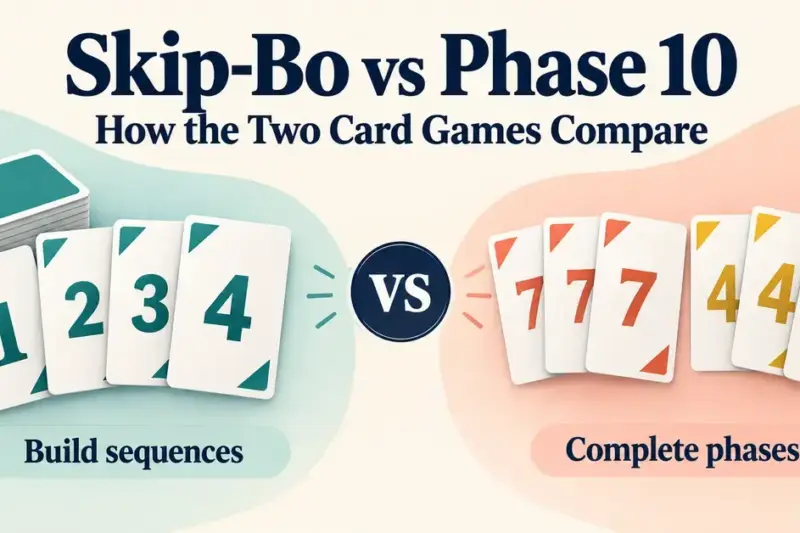
The closest comparison people ask about is Skip-Bo vs UNO, since both are Mattel classics but play nothing alike — one is about building sequences, the other about matching and shedding. For the rummy-style cousin, see Skip-Bo vs Phase 10, and for the wider field of options, browse games like Skip-Bo.
Common Skip-Bo mistakes and mix-ups
The most common Skip-Bo errors are procedural, not strategic, and they trip up new players before tactics ever come into it. The biggest is forgetting that a turn ends the instant you discard — players often discard a useful card by habit and then realize they could have played more first. Another is treating the discard piles as a dumping ground rather than a resource; because only the top card of each discard pile is playable, burying a low number under higher ones locks it away.
A few mix-ups are worth clearing up directly. The card colours (blue, green, red) never affect play — they exist only for accessibility, so ignore them when planning a move. Skip-Bo Junior is a separate, simpler edition, not the same game with a different box, so its 1-to-10 rules won’t match a standard deck. And despite often sharing a shelf with UNO, Skip-Bo is a completely different game: there is no colour-matching and no “UNO” call. If you want the exact procedure with none of these pitfalls, the full step-by-step rules lay every turn out in order.
Reference sources
Frequently Asked Questions
Is Skip-Bo the same as UNO?
No. Skip-Bo and UNO are both Mattel card games, but they are played very differently. Skip-Bo is a sequencing game where you build piles in numerical order from 1 to 12 to empty a stock pile, while UNO is a matching game where you shed your hand by matching the colour or number of the top card. They share a publisher and a family-game reputation, not a rule set.
How many cards do you deal in Skip-Bo?
The deal depends on the number of players. With 2 to 4 players, each person receives a stockpile of 30 cards; with 5 or 6 players, each receives 20 cards. For a quicker game, you can deal a smaller stockpile of 10 or 15 cards instead, and for a long two-player game, some players deal up to 40.
Can you play Skip-Bo with a regular deck of cards?
Yes. Because Skip-Bo is based on the older game Spite and Malice, you can recreate it using standard playing cards, treating the number cards as 1 through 12 and using jokers or a chosen card as wilds. The gameplay is the same in principle, and a dedicated guide on this site walks through the exact conversion.
How many players can play Skip-Bo?
Skip-Bo is designed for 2 to 6 players. It can be played individually as a free-for-all, in partnerships, or in teams, and Mattel’s rules include a partnered format where teammates cooperate to empty both of their stock piles.
What age is Skip-Bo suitable for?
The standard Skip-Bo game is recommended for ages 7 and up. For younger children, Skip-Bo Junior is designed for ages 5 and up, using a shorter 1-to-10 sequence and two difficulty levels so the game can grow with the child.